

Topics in this article:
- Background: How the Bosman ruling opened football’s labour market
- Most World Cup players now ply their trade abroad
- The English, Spanish and Italians tend to stay home
- Germany’s national side is drawn abroad again
- France, Argentina and Brazil: top of the table for players abroad
- After Bosman: European club football goes global
- Europe’s five major leagues compared
- What the 2026 World Cup tells us about a globalised world
- In detail: all 48 nations of the 2026 World Cup
- Methodology
eToro

eToro
Vorteile
- Kontoeröffnung kostenlos
- Demokonto mit 100.000 $ virtuell
- CopyTrader-Funktion
- Kryptowährungen handelbar
Nachteile
- Spreads fallen an (u. a. CFD, Krypto)
- Aktien: 1 oder 2 $ Provision je Order
- 5 $ Gebühr bei Auszahlung vom USD-Konto
Buzzmatic GmbH & Co. KG übernimmt keine Haftung. Auch kann keine Gewähr für die Aktualität der bereitgestellten Informationen übernommen werden. Maßgeblich sind die Bedingungen des Anbieters.
Scalable Capital

Scalable Capital
Vorteile
- 0 € Depotgebühren
- Sparpläne ab 1 € ohne Sparplangebühr
- Über 8.000 Aktien, mehr als 2.700 ETFs
- Anleihen, Fonds und Derivate handelbar
Nachteile
- FREE: 0,99 € je Trade (PRIME-ETFs ab 250 € 0 €)
- PRIME+-Flatrate 4,99 € im Monat
- Xetra und gettex 1,99 € je Trade
- Zzgl. Produktkosten und Spreads
Buzzmatic GmbH & Co. KG übernimmt keine Haftung. Auch kann keine Gewähr für die Aktualität der bereitgestellten Informationen übernommen werden. Maßgeblich sind die Bedingungen des Anbieters.
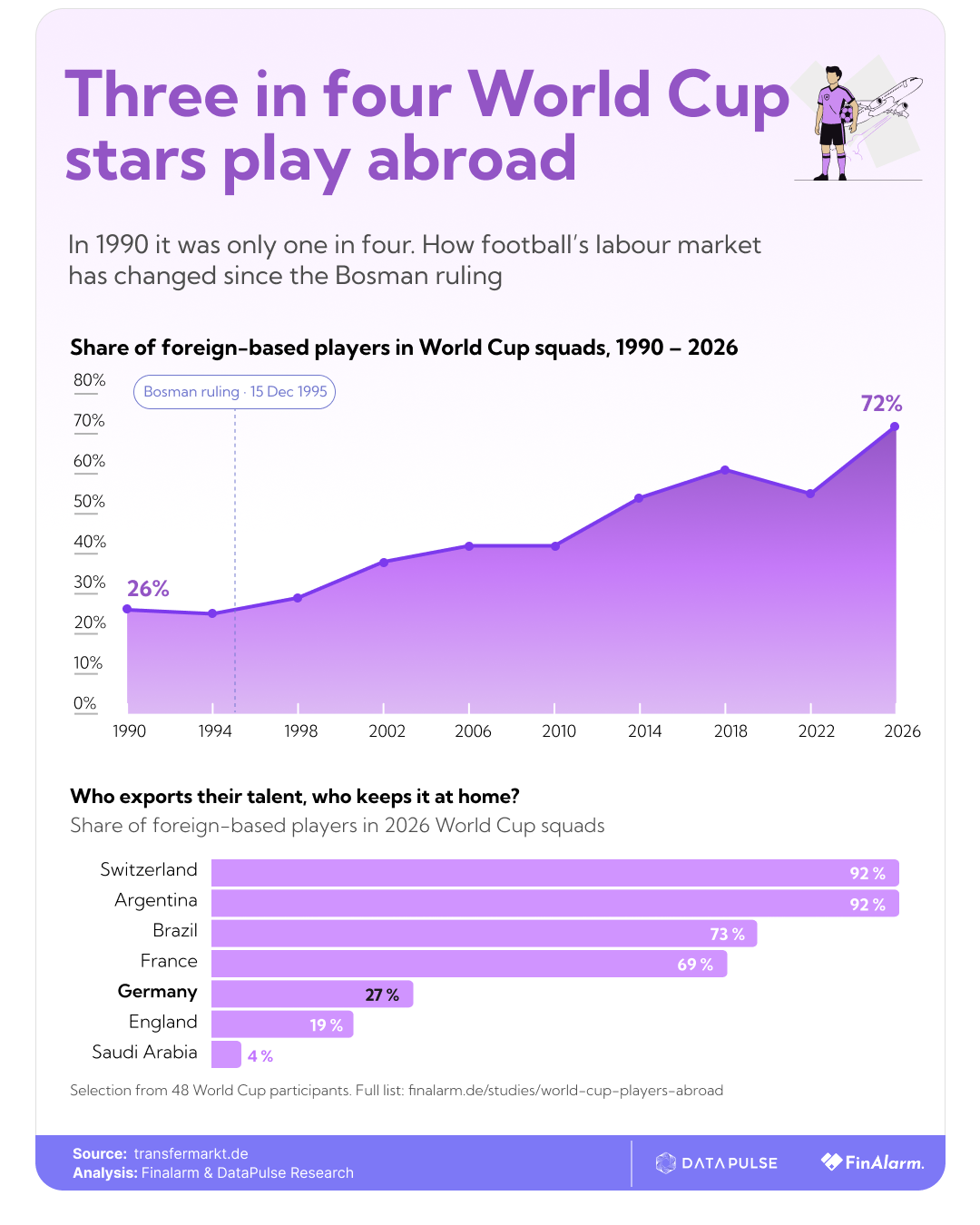
Since 1990, the share of national-team players playing abroad has almost tripled.
1-1, Stoichkov from a free kick, 75th minute. 2-1, Lechkov with a header, 78th. The shock was complete: in the summer of 1994, footballing minnow Bulgaria knocked out the favourites and defending champions, Germany, in the World Cup quarter-final in East Rutherford, New Jersey. More than thirty years later, the World Cup returns to the United States. The world has changed radically since, and so has football.
The sport and its labour market have grown more open and global. Since 1990, there has been a genuine migration of skilled labour: at the 1990 World Cup, 26% of national-team players were based at foreign clubs; at this year’s tournament, the figure is 72%. Over the same period, the share of players with a foreign or migration background in Europe’s five major leagues climbed from 23% to 71%.
That is the finding of a new study by the finance portal Finalarm and the data studio DataPulse. The analysis traces how the opening of the European football market reshaped transfers and squad composition, and continues to shape them today.
Jump straight to the interactive comparison: All 48 World Cup nations ↓
Background: How the Bosman ruling opened football’s labour market
Bulgaria’s World Cup heroes, Hristo Stoichkov and Yordan Lechkov, played for FC Barcelona and Hamburger SV, respectively, in 1994. They were players based abroad, not contracted to clubs in their home country. Until the mid-1990s, that was far from the norm.
National leagues and UEFA’s European competitions enforced the „3+2“ rule, which limited each team on the pitch to no more than three foreign players, plus two „assimilated“ players who had spent years in the country.
The Bosman ruling of the European Court of Justice, handed down on 15 December 1995, ended that system. It established that professional athletes enjoy the same rights as any other worker. Hamburger SV could, in principle, field eleven Bulgarian or Brazilian players today.
eToro
Kostenloses Konto & Demokonto
Vorteile
- Kontoeröffnung kostenlos
- Demokonto mit 100.000 $ virtuell
- CopyTrader-Funktion
- Kryptowährungen handelbar
- Smart Portfolios verfügbar
Nachteile
- Spreads fallen an (u. a. CFD, Krypto)
- Aktien: 1 oder 2 $ Provision je Order
- 5 $ Gebühr bei Auszahlung vom USD-Konto
Scalable Capital
Gebührenfreie Depotführung
Vorteile
- 0 € Depotgebühren
- Sparpläne ab 1 € ohne Gebühr
- Über 8.000 Aktien handelbar
- Mehr als 2.700 ETFs
- Anleihen, Fonds, Derivate
Nachteile
- FREE: 0,99 € je Trade (PRIME-ETFs ab 250 € 0 €)
- PRIME+-Flatrate 4,99 € im Monat
- Xetra und gettex 1,99 € je Trade

SMARTBROKER+
2,25 % Zinsen p. a. (variabel)
Vorteile
- gettex: 0 € ab 500 € (Premiumpartner)
- Über 30 Handelsplätze
- Über 10.800 Sparpläne
- 2,25 % p. a. (variabel) bis 100.000 €
- Depot- und Kontoführung kostenlos
Nachteile
- gettex unter 500 €: 1 € je Order
- Ohne Premiumpartner 4 € je Order
- Telefon-Service Mo–Fr 9–17 Uhr

Tarifcheck
100 % kostenlos & unverbindlich
Vorteile
- Seit 2001 am Markt
- Vergleiche für alle Lebensbereiche
- 100 % kostenlos & unverbindlich
- In Minuten fertig
- Neutraler Vergleich
Nachteile
- Kein eigener Abschluss – dafür neutral
- Provisionsfinanziert – dafür kostenlos
- Kein Vor-Ort-Berater

Consorsbank – Wertpapierdepot
0 € Sparplangebühr für ETFs
Vorteile
- Alle ETF-Sparpläne ohne Sparplangebühr
- Aktien-Sparpläne 12 Monate gebührenfrei
- 0,95 € je Order über Tradegate im 1. Jahr
- Kostenlose Depot- und Kontoführung
Nachteile
- Jeweils zzgl. marktüblicher Spreads
- Ab 2. Jahr: 4,95 € + 0,25 %, mind. 9,95 €
- Aktien-Sparpläne ab Monat 13 kostenpflichtig
- Angebot nur für volljährige Neukunden
XTB
Negativsaldoschutz inklusive
Vorteile
- Aufsicht: KNF (Polen), BaFin-registriert
- Aktien & ETFs ohne Kommission bis 100.000 €/Monat
- ETF-Sparpläne
- Negativsaldoschutz
- Kostenlose Ein- und Auszahlungen
Nachteile
- 0,5 % Gebühr bei Währungsumrechnung
- Über 100.000 € Monatsumsatz 0,2 % Kommission (mind. 10 €)
- CFD-Handel mit hohem Verlustrisiko
Buzzmatic GmbH & Co. KG übernimmt keine Haftung. Auch kann keine Gewähr für die Aktualität der bereitgestellten Informationen übernommen werden. Maßgeblich sind die Bedingungen des Anbieters.
Infografik: Three in four World Cup stars now play abroad
All the key figures of this study in one interactive graphic: the rise of foreign-based players in World Cup squads, the 2026 share for individual nations, and the same trend inside Europe’s five major leagues. Switch views, use the filter and tap any bar for the exact value and its source. The button at the foot of the graphic saves it as a PDF. You can find more visualizations on business and finance topics in our collection of infographics.
Four squads that once kept everyone at home
Each nation is shown at the tournament where none of its players was based abroad, and again in 2026. Switch between the two snapshots.
The baseline year differs by nation because it marks the tournament at which the share was zero. Source: Finalarm and DataPulse analysis of Transfermarkt data and official squads.
Stand: 02.09.2026
Most World Cup players now ply their trade abroad
The liberalisation of European football has, over the past three decades, drawn ever more top players abroad. In World Cup squads, the share of players based at foreign clubs has risen from 26% in 1990 to 72% in 2026. Die Analyse zeigt, dass bei der WM 2026 somit drei Viertel der Stars im Ausland spielen und als Legionäre gelten.
A player counts as "based abroad" here if, according to transfermarkt.de data, they were contracted to a club outside their national team's country at the time of the respective World Cup. In 1990, for example, Lothar Matthäus and Jürgen Klinsmann played for Inter Milan. In this year's German squad, Antonio Rüdiger of Real Madrid and Florian Wirtz of Liverpool are among the prominent names abroad.

The English, Spanish and Italians tend to stay home
The trend toward more World Cup players at foreign clubs holds regardless of the starting point, but there are striking differences.
At the 1998 World Cup, not a single Spanish or English player was based abroad; every one was contracted to a club in their domestic league. By 2026, the share playing abroad has risen to 19% for England and 35% for Spain.

In England's and Spain's national teams, the share of players abroad is comparatively low. One explanation: England has, by UEFA's five-year ranking, the strongest league in the world. Spain ranks third, narrowly behind Italy. Naturally, the best clubs in the best leagues also hold on to a large share of their home-grown talent.
The make-up of Italy's national team supports this thesis too, at least up to 2014, when the Azzurri last qualified for a World Cup.
Germany's national side is drawn abroad again
Germany offers a telling picture: after the surprise quarter-final exit of 1994, the share of players based abroad fell steadily. At the 2010 World Cup in South Africa, every German international played for a German club. Since then, however, the team has internationalised again, with German players increasingly drawn abroad. Compared with all World Cup participants, though, Germany's share of foreign-based players remains relatively low.

France, Argentina and Brazil: top of the table for players abroad
France, home to the world's fifth-strongest league, has a foreign-based share of 69% this year. After all, the French, led by Kylian Mbappé, lifted the trophy in 2018 and were beaten only on penalties by Argentina four years ago.
For countries like Argentina and Brazil, where a large share of the best players already moved abroad before the Bosman ruling, the figure remains high (Argentina 92%, Brazil 73%). European clubs recruit far more than just superstars like Messi or Vinícius Júnior.

These exports are nothing new. Back in 2002, at Brazil's most recent World Cup triumph, the majority of the squad was already based abroad: that year, the Brazilians beat Germany in Yokohama, Japan. South Korea, meanwhile, is the only Asian side to have qualified for each of the last ten World Cups. In 1990, the South Korean squad consisted entirely of players in the country's top division. This year, only around 27% play at home. South Korea's squad illustrates the overall trend toward internationalisation especially clearly:

Looking across all eight World Cup nations, the same trend toward internationalisation appears, if to differing degrees: most dramatically in South Korea, most stably in Germany and England.

After Bosman: European club football goes global
What is true of World Cup squads over recent decades also holds for club squads in Europe's five major leagues (England, Italy, Spain, Germany, France): football is becoming ever more international. In 1990, fewer than a quarter of players at these clubs came from abroad or had a migration background (i.e. they hold a non-domestic nationality or were born abroad). Today, almost three-quarters of them do.
The chart below shows this rise among the top players (who, in at least one of three criteria, ranked in the top 5% of their league in a season: goals per match, goals per minute played, or minutes played per match), and across full squads, the figures are practically the same.

The biggest jump came between 1995 and 1997, immediately after the Bosman ruling: the share of players with a foreign or migration background rose by 16 percentage points. Since 1997, average growth has settled at about one percentage point per year.
Europe's five major leagues compared
England's Premier League has by far the strongest growth in players with a foreign or migration background since 1990 and remains one of the most open leagues in Europe.
France's Ligue 1 currently holds top spot, at 88%. Italy's Serie A and Germany's Bundesliga follow almost level, at around 73%. The Bundesliga, however, showed a long maturing phase after an early boom: it first crossed the 60% mark back in 2002. In Italy, this share stood at just 35% at that point; the growth trend that continues to this day only began in 2007.
The most "national" league of the five is Spain's La Liga, where the share of players with a foreign or migration background recently reached 45%, only four percentage points more than in the post-Bosman year of 1997.

What the 2026 World Cup tells us about a globalised world
This short excursion into football history makes one thing very clear: since the shock of that 1994 summer in the USA, the sport has become not just more international but fundamentally more global. The European labour market was liberalised, and football's most skilled workers went where the best jobs were. Three decades on, the result is a game whose clubs and squads span the entire world.
The same trend is reflected in national teams. World Cup squads have featured ever more players based abroad since 1990, across every country. The exceptions are, above all, the nations with the strongest leagues that can keep a share of their talent at home.
That the 2026 World Cup returns to the United States closes a circle. Three decades of Bosman have produced a sport more globalised than almost any other industry, and national teams in which three of every four players now work for a foreign club. Anyone following the 2026 World Cup is watching not only the best footballers in the world but also looking into a world where talent, dreams and shirts have long since stopped recognising borders.
One last question: can the data predict a World Cup winner? Sadly, no. Lately, teams stacked with players abroad have done well, but before them, so did the Spanish and Italians who prefer to play in their home leagues. There is, however, one thing the data can tell us for certain: Bulgaria, the side that stunned the favourites in 1994, did not even qualify for 2026.
In detail: all 48 nations of the 2026 World Cup
For those who want the full picture: here are all 48 World Cup participants compared directly, sortable by Top 10, Bottom 10 or the major footballing nations.
Methodology
Object of study
The study examines two related but opposing phenomena:
- Outflow from national teams: the share of World Cup squad players contracted to a foreign club at the time of the respective tournament. Measures how international a country's top talent pool has become.
- Inflow into the leagues: the share of players with a foreign or migration background in Europe's five major leagues (Premier League, Bundesliga, Ligue 1, La Liga, Serie A). Measures how international each league's player pool has become.
Sample selection
National-team analysis (1990–2026). Because the number of World Cup participants nearly doubled over the observation period (24 in 1990 to 48 in 2026), a time series across all participants would be methodologically inconsistent. The analysis is therefore limited to 14 nations that qualified for (almost) every World Cup in the period: Argentina, Belgium, Brazil, Germany, England, France, Italy, Mexico, Netherlands, Portugal, Sweden, Spain, South Korea, and the USA. All 14 nations contribute to the historical trend line (Chart 01); the 2026 value, by contrast, covers all 48 participants (see "2026 World Cup"). Eight of them are shown individually as small multiples in Chart 06 (Eight World Cup nations compared); the remaining six (Belgium, Mexico, Netherlands, Portugal, Sweden, USA) appear only in the aggregate.
League analysis (1990–2025). All players who made at least one appearance in a season (minutes played > 0) at the clubs of the five major European leagues. The Premier League is included from its founding in 1992.
2026 World Cup
For 2026, the official World Cup squads of all 48 participants are used (source: Wikipedia, Transfermarkt). The overall figure of 72% of national-team players abroad refers to all 48 participating nations. The long-run trend line (Chart 01) is based, up to 2022, on the 14 nations that qualified for (almost) every tournament, to keep the time series comparable as the field grew from 24 to 48 teams; its 2026 endpoint shows the overall value across all 48 participants.
Operational definitions
- "Player abroad" (national-team player at a foreign club): a player in their country's World Cup squad contracted, at the time of the tournament, to a club outside the country of their national team.
- "Player with a foreign or migration background" (in a league): a player who holds a nationality other than that of the country of the league in which they play (dual nationals count as such), or who was born outside that country. Conversely, a player counts as "domestic" only if they were born in the country of their club and hold that nationality.
- "Top player" (in the top 5th percentile, used in Chart 07): a player who, in a season, ranked in the best 5% of their league on at least one of three criteria: goals per match, goals per minute played, or minutes played per match.
Aggregation across the 14 nations
The national-team share of players abroad (Chart 01) is calculated as a player-weighted share: the sum of all players abroad across the 14 squads ÷ the sum of all players in the 14 squads. It is not a simple average of the country figures. Larger squads carry slightly more weight; the value corresponds to the share for a player drawn at random from the overall pool.
Missing data
Several nations did not qualify for every tournament in the observation period:
- Italy: included up to 2014; excluded for 2018, 2022 and 2026 (did not qualify).
- France: included from 1998 (did not qualify in 1990 and 1994).
- England: excluded only for 1994 (did not qualify for the 1994 World Cup).
- All other nations: included for every tournament in which they took part.
Tournaments for which a nation did not qualify are excluded entirely, not imputed; the aggregate denominator therefore varies slightly between years.
Limitations and caveats
Scope of the Bosman ruling. The 1995 Bosman ruling liberalised player movement within the EU. Players from non-EU states remain subject to national work-permit regimes that vary by country. The phrase "global liberalisation" in the article is a simplification: many of the observed changes reflect intra-EU mobility rather than a worldwide free labour market.
Brexit effect. Since 2021, the Premier League has applied stricter work-permit rules for signings from non-UK countries (Governing Body Endorsement, GBE). In addition, the league's new Profit and Sustainability Rules (PSR) apply. These rules apply solely to the Premier League and cannot be transferred to the other four leagues.
Baseline year 1990. The starting year coincides with German reunification (1990) and the early collapse of the Eastern Bloc (1989–91), which released Eastern European player flows independently of the Bosman ruling. Part of the early-1990s rise, therefore, reflects post-Cold-War mobility, not the Bosman ruling alone.
Other factors. The rise in the share of players with a foreign or migration background over 35 years also reflects the expansion of TV rights, club spending, the globalisation of player agencies, and Gulf-state investment in European clubs. Bosman is the single most cited turning point, but it is not the only cause.
Sample limitation. The long-run trend analysis covers 14 of the 24–48 World Cup participants per year (representative of World Cup regulars); the 2026 snapshot, by contrast, covers all 48 participants. The league analysis covers only Europe's five largest leagues, not second divisions or non-European competitions.
Source consistency. The World Cup squad data come from the official tournament squads (Wikipedia, 1990–2026); players' nationalities and club affiliations come entirely from Transfermarkt. Consistency of player attributes across sources was checked on a sample basis but not systematically.
Data sources
- Players' place of birth, nationality and club affiliation: transfermarkt.de
- World Cup squads and club affiliation, 1990–2022: FIFA World Cup squads on Wikipedia
- 2026 World Cup squads: 2026 FIFA World Cup squads (Wikipedia)
- League-strength reference: Opta Power Ranking: League Strength, as of 20 May 2026